
Huh? It’s the first day of Spring, what’s with that title?
A month ago, Peg posted “We are less than 30 days from the reason we have sheep, from the day that just about beats Christmas for me – Shearing Day!”
Well, today is Shearing Day. Leading up to it, she was acting like a kid waiting for Santa’s arrival. I got home from work around 5:15 yesterday, and with the great late day light that is Daylight Savings, announced that I would like to start preparations for shearing in the barnyard. While she agreed, she also commented on how “anxious” she was feeling. And this morning, we got up around 6:30, but Peg apparently had been tossing and turning since 4:00.
Yesterday’s prep work – get the boys penned in a small paddock near the barn (and away from the hay) and plow out the snow that has drifted in front of the barnyard gate. Why pen the boys? We’ve learned that the flock should be: 1) kept dry and 2) slightly starved before the shearer arrives. Dry wasn’t a problem yesterday – the skies were clear, the temperatures were below freezing. No food? That’s to help ensure the animals don’t poop while the shearer is doing her work. Why plow in front of the gate? We were expecting quite the crowd this morning and we wanted to make it easy for everyone to get in the barnyard.
This morning – around 7:00 we headed out to get the flock ready. I promised Gwen Hinman, our shearer, that the animals would be all penned in when she arrived at the farm, and the plan was for her to show up around 8:45. The challenge was twofold – first get 15 ewes, 3 lambs and 2 wethers penned into the 20 x 30 foot barn, second to get them jam packed into a 10 x 14 foot corner of the barn. We had a few missteps, but it didn’t take too long or too much effort. Trying to get them penned into the corner was the tougher task. We each had 8 foot panels and were slowly trying to get them to pass through a 4-foot gap between a feeder and the barn wall into the corner. The key – get one or two animals to pass through and the rest begin to follow. Why such a small pen? The more packed the flock, the less room for them to run around trying to avoid my capture. We literally want to pack them in.
We made the pen for the 4 boys even smaller. This pen was outside the barn – about 20 feet from the open east wall. My plan was to take them, one at a time, from the pen into the barn, where Gwen would shear, and then take them back. We headed back into the house around 7:30. Back inside, I could tell that Peg was upset. Why? She thought the boys’ pen should be right next to the barn, not 20 feet away. I headed back out and figured out how to do that – it was actually pretty easy.
The first of our helpers – Roanne – showed up around 8:00. We all had a little breakfast and shared shearing and sheep stories. Gwen arrived at 8:45. When we all got back up to the barnyard, Peg thanked me for moving the boys.
Gwen got herself all set up on a 4 x 8 foot sheet of particle board I had left over from last summer’s insulation job. Additional helpers John, Lise, Susie, and Callie were all in the barn and barnyard by the time Gwen went to work on the first sheep at 9:15. The order of shearing, for the most part, was 1) jacketed white – Levi, Schuyler, Henrietta, and Mandy; 2) unjacketed white – Rita and Eleanor; 3) the colored boys – Calvin and Nash – so we could let the boys back out into their field and their hay; 4) jacketed light colored girls – Louise, Hillary, Jackie, and Jewel; 5) light colored Cormos – Hannah, Rosie; 6) dark colored Cormos – Willow, Ralph, Chuck, Scampy, Cedar; 7) dark colored Corriedale ewes – Ella, Dolly, Martha; and 8) dark colored lambs – Yoohoo and Christy. Here is a video of Gwen with Calvin…

Video of Gwen Shearing Calvin
Some of these sheep are big, I mean really big. Once I got into the ewes’ corner pen, I would pick out an animal and walk/nudge/push/shove them to the gate. Gwen would slide the gate open and we would try to work together to move them about eight feet across the hay covered floor to the particle board. These animals have four legs, two more than we do, and many of them use them as very effective brakes to keep us from making forward progress. They are STRONG! They are STUBBORN! Once they were on or close to the board, I would step away and let Gwen do her work. For most, she would wrench the sheep’s neck back and use her hips for leverage to get them on their butts. A handful were very difficult to maneuver, only one got loose in the barn.

Todd, Gwen Moving Sheep
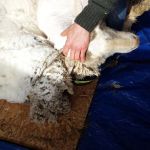
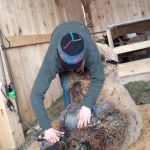
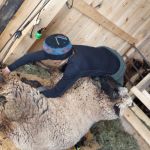
Gwen was AMAZING – calm, expert, efficient, and quick. First step – take clippers out of her back pocket and trim the hooves. Next, pick up the electric shears, turn it on, and shave the animal’s stomach. Often this part of the fleece was covered with muck. She would toss that stuff onto the tarp on one of the helpers would put it in the garbage bag. Once the underbelly was done, Gwen would work her way down a hind leg (again, useless growth but in need of a cut) then work her way across the butt and back. Once about half of the fleece was off she would take the shears straight up under the chin and then work across the sheep’s left shoulder. Next, trim the top and sides of the head and then on to the right shoulder, right front leg, back, and hind leg. Total time – less than 8 minutes. In fact, she did all 24 sheep in almost exactly 3 hours – that’s 7.5 minutes an animal. And she took breaks, refilled her coffee, grabbed a snack, chatted with the helpers (including Michael Hampton – our wonderful processor).
-

- Levi
-

- Schuyler
-
- Schuyler II
-

- Calvin
-

- Look At That Color
-

- Stomach Cut
-

- Roanne Cleaning Up

-
- Louise
-

- Ella
-
- Cormo
-
- Christy
We had additional helpers and visitors during the morning. Vicky surprised us all. We knew she really wanted to come, but she had to be at work. She announced she was taking a “mental health” day off to be with us. Betty, Ann and her husband Ted came by to help as well. If you’re not moving or shearing sheep, what are you doing to help? First, someone has to take the fleece – which Gwen has expertly taken off the animal in a single piece “blanket” – off the particle board, walk it across the barn and throw it – top side up – onto the skirting table. Susie showed Peg how to do it so each fleece would fall perfectly on the table. Only problem – these animals are so big they produce HUGE fleeces and Peg is pretty petite. After the first several fleeces, Peg invited John to try it. John, being quite a bit taller, quickly got the hang of it and moved the remaining fleeces.
Once the fleece was on the table it was surrounded by about 6 skirters, picking hay, muck, whatever isn’t great fleece out and tossing it into bags positioned at each corner of the table. Once it was deemed “clean”, it would get rolled up and put into a large plastic bag. From there, Callie would weigh it using a scale hanging outside the barn and put a card in the bag bearing the sheep’s name.
-
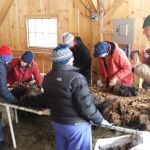
- Skirting Table
-

- John, Lise, Betty
-

- Break Table
-
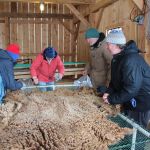
- A BIG fleece
The helpers are sheep/wool/yarn experts. Many of them have been spinning and knitting for years. Why do they take a half day out of their busy lives to stand around in a cold barn? Because they want to see, feel (smell?) the fleeces. White fleece is white fleece. But jacketed white fleece is spinner’s gold. And the colors! Cinnamon, mocha, light gray, medium gray, dark brown, almost black. We’ve learned to be surprised when the shears do their work. The bulk of the fleece – the stuff we can’t see beneath the top coat that has been bleached by the sun – often is a completely different color. And, as the animals age, their fleeces change color – the dark ones in particular getting more gray. We all were amazed by the colors we saw.

Look At That Color
While color is great, it’s the feel of the fleece that really gets these people excited. The softness, the crimp, the long staple. People were amazed by the quality of the fleece. How amazed? Almost all of the helpers – six – put claims on fleeces:
- Schuyler – 6 pounds jacketed white, gone
- Levi – 7.5 pounds jacketed white, gone
- Eleanor – 8.5 pounds unjacketed white, gone
- Calvin – 4 pounds unjacketed cinnamon, half gone (we’re keeping the other half – we’ve sold him both prior years)
- Martha – 5.5 pounds unjacketed gray white a really long staple, gone
- Jackie – 6 pounds jacketed mocha, gone
- Ella – 7.75 pounds jacketed black, gone
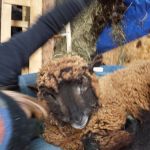
- Christy – 4.5 pounds unjacketed black, gone
Next step – a few fleeces were damp and need to be dried out. The unjacketed fleeces will head to Michael’s fiber mill in about a week or so. The jacketed fleeces we will try to sell unprocessed to other hand spinners.
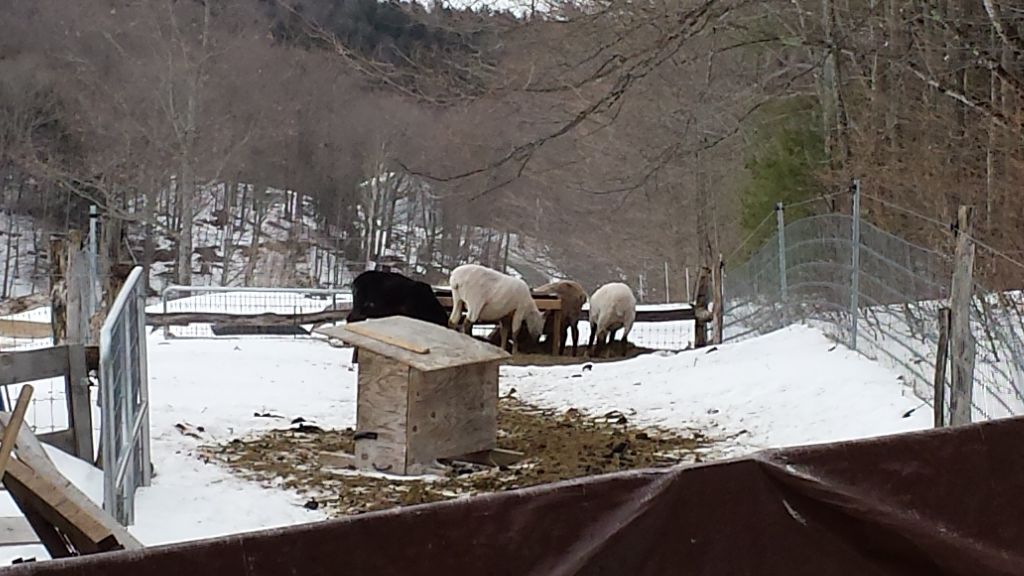
Sheared Boys
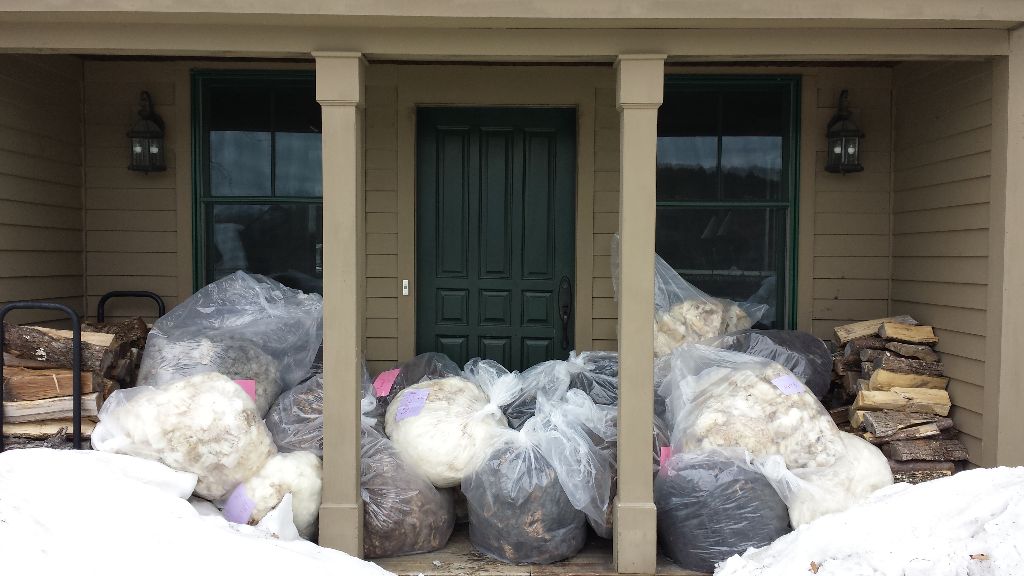
Unclaimed Fleeces
The proceeds will go to our Christmas fund – paying for hay.
Todd
it sounds like Calvin is saying ‘burr’!
Great Post Todd! Congratulations!! Now how many lambs do we think are coming?
I would love some more information of fleeces that you have up for sale.
Wow, great video! Thanks for all the detail Todd, really makes it come to life.
Great description of fleecing day. It was very interesting to read. Congratulations on a successful day! Looking forward to seeing you at the NFM in May!