
Why should this year be like last year? We have more sheep, more snow, more bitter cold, more things to go wrong. I shouldn’t say wrong. Different. Why did I think that if we mastered our first year, we’d be ahead, we’d be ready, we would know more. We do know more, but we are learning we also know less. In Rumsfeld speak, the known unknown and unknown unknown are upon us.
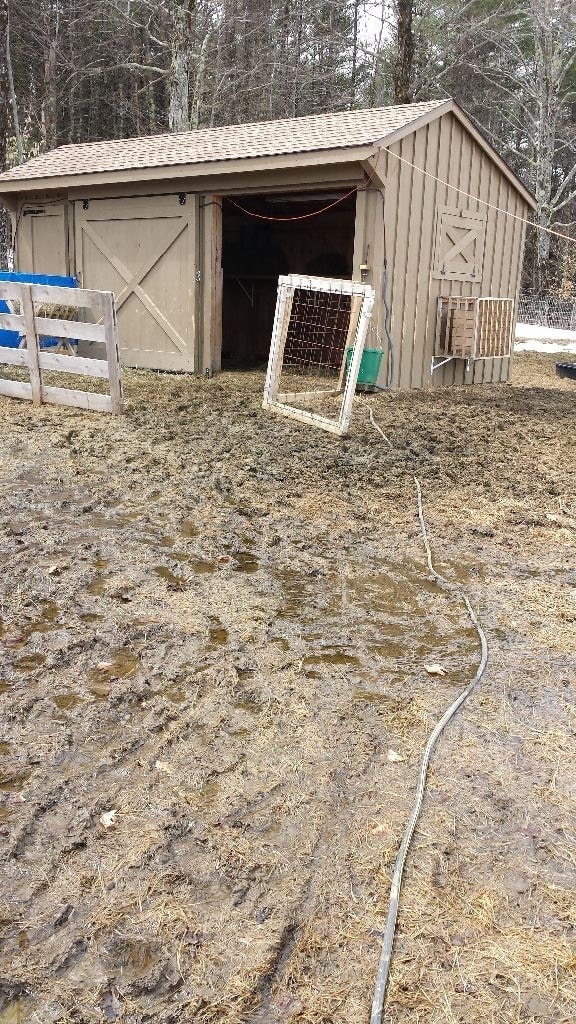
Poopy Quagmire
The barnyard is a poopy quagmire. The barn is still flooding. Lambing is late. A pregnant ewe has a prolapsed vagina. Calvin’s limp is not anything like ones we’ve handled so far. “Do you see how his shoulder muscle has atrophied?” asks Dr. Pinello during an emergency farm visit on Sunday. “He’s probably been hiding the injury from potential predators. That injury has been around long enough to reduce those shoulder muscles. Do you see that?” I do now. I didn’t know to know to look. I’d only been focused on his hoof. And she wasn’t really here to see Calvin. She was here to help us with the prolapsed vagina.
In a sideways cold rain with frost on the ground Todd and I had gone up to the barn where the five moms-to-be sheltered from the wet. Four were up and giving us the once over in search of the shallow plastic bin that said, “grain!” Hillary was lying huddled in the corner, shivering. We knew to take her temperature. I found three thermometers in the house. Two had dead batteries and the third one said my temperature was 95.5. I didn’t know battery operated thermometers could die so fast or work and be so wrong. We called the Vet.
Lunch time on Friday I’d gone up to the barn to check the hay supply in the feeder and just maybe see some lambing action. It was warm and all the girls were lounging by the feeder chewing their cud and probably discussing how finally the weather had turned nice. I eyed the crowd looking for each of the pregnant ewes. Hillary was seated, her hindquarters facing me, a wet ball of something protruding from her rear.
The picture wasn’t squaring with what I knew lambing looked like. “This is different. But maybe it’s a lamb. I don’t think so.” I ran to the house to call Todd knowing it would take him at least 15 minutes to get home. I went back to the barnyard. The protrusion had disappeared, I knew it wasn’t a lamb. I was also pretty sure it wasn’t a prolapsed uterus – that image I’d seen projected in glorious gory color on an auditorium’s monster screen near the beginning of the Sheep Problems for Dummies lecture at Cornell’s Sheep and Goat Symposium the fall we decided we were going to make the sheep farming leap. At the time I thought, that’s just a scare tactic to weed out the weak. Oh, what I didn’t know. But if what I saw wasn’t a uterus and it wasn’t a lamb, what had I seen?
Google provided the answer. What I had seen was a white softball in a mesh of red veins, a prolapsed vagina. It didn’t make sense. I didn’t understand why it was round. Shouldn’t there be a hole for the cervix? In my mind I saw the text book drawing of the parts for female human reproduction and could not figure out how a vagina can hang outside the body as a big fat ball with, well, with the other stuff staying put. In short: I knew what to call what I had seen, but I had no damn idea what it meant or how to fix it. I called the Vet.
Doctor Pinello was on the line in under a minute. “Based on what you have described, it’s a prolapsed vagina. That needs to be pushed back in and kept in. You need to tie her up with twine. Do you understand? You need to fashion a harness. I can come up if you’d like, but you need to get a harness on her. Do you understand?”
I knew what twine was and I knew I could Google “prolapse sheep harness.” “Yes. We’ll figure it out. Thanks.” Even as novice sheep farmers who hope someday to make this something of a business, we know you don’t have the Vet visit unless you are truly without your own options. The visit would cost more than we paid for the animal.
Todd was now home printing harness instructions. We have miles of twine thanks to the three hundred plus bales of hay we’ve been through this winter. We tied several together and with Todd holding Hillary still, I folded the rough thin roping in half, looped the twine over either side of her shoulders, under her front legs, up and across her back, down under the belly, around either side of her swollen udder, and brought the two lines up between her hind legs and pressed them against her swollen lips and handed the ends of twine to Todd who held them taught by her neck. I connected two short pieces of twine to the lines that had come up between her legs, laying them across her lips and making a gate of sorts. We tied the ends that Todd held to the original fold up at her neck, tightening the harness, which further pressed the gate section against the vulva and released Hillary.
It lasted a few hours. We tightened it further. The two pieces that we supposed stay over the lips to prevent anything from falling out kept slipping down. Saturday morning we started all over with fresh twine. Hillary was easy to handle, but the thought of readjusting this makeshift harness for hours or days was discouraging.
We headed down the hill to set up our stall at the indoor farmers market where we’d sell our yarn, blankets and talk up the apartment, but the twine harness was really what was on our minds, that and the fact that I would have to leave Sunday night for three nights. How was Todd going to handle five very pregnant sheep, a failing twine harness, and a prolapsed vagina? Oh, and a day job.
The market runs from 10 in the morning until 1pm. At noon, Lise, a sheep farmer for over 30 years, stopped by. She had come to our shearing day and helped rescue escapees. Today, she’d come to the rescue again. I told her about the twine harness and she told me she had a paddle and a real harness and that we should come borrow it as soon as the market was done. The moment the market closed, we could not have packed up faster. When we arrived at Muscle in Your Arm Farm, Lise had the red nylon harness set out, a sheep book opened to the section on managing prolapse parts, and the paddle. The rigid white plastic paddle is “T” shaped. A five inch flat tongue makes up the stem and the top of the “T” is a curve of thin plastic with small holes at each end.

Harness

Paddle
In her self-deprecating, humorous way, Lise described how to work the harness and the paddle and sent us on our way with words of encouragement. Back at the barnyard, Hillary’s twine harness had slipped too low and the softball had emerged again. We cut away the twine, laid the nylon harness on her back, pulled the straps under her legs and snapped the pieces in pace. Two half inch straps ran down either side of her lips. Two more ran just above and below forming a rectangle snug around her vulva. We loosened the straps and with one hand I pushed and held the vagina in and slowly inserted the plastic paddle into her vagina. Twine was tied at either end of the “T” bar which we used to secure to the harness itself. Now the paddle was inside Hillary and held in place with the T and twine.

Hillary in Harness
Instantly we knew this was a far better means for containing the situation. Do you keep the paddle in place when they’re lambing? Is she close to labor? Should we be worried about the mucus discharge I saw when I put the vagina back in for the last time? Is it really necessary to cull a ewe that has this condition? Even her lambs? Googled information with no understanding. Barn watch at midnight and 2:30am were uneventful, but when we arrived in the rain in the morning, we knew we didn’t know enough to tell if shivering Hillary needed help. It would be an expensive visit, but we did know it was we who needed help. It was time to call the Vet.
Dr. Pinello arrived as the rain was thinning out. After quick introductions she asked for a bucket of warm water. Todd headed off for the water and Dr. Pinello calmly told me that while she’ll check on Hillary the real business to be done was to teach me how to know the condition of our ewe and how to do an internal exam. For the next hour, Todd and I went to school on Hillary. We learned how to wash the vulva, how to wash ourselves. It was understood that if there was going to be an internal exam, it would be done by me because my hands are much smaller than Todd’s.
Dr. Pinello did the exam first. “You can use gloves. I prefer not to.” She laced the fingers of her two hands and folded them into a single fist and explained how the cervix unfolds like leaves. “But if it’s closed, this is what it will look like” she said as she nodded toward the thumb of the fist. “Do you understand?” She did the exam and said it was now my turn. There was no way I was going to limit my sense of feel with gloves.
I washed my hands and arms and with my left parted Hillary’s lips and slid the tip of my cupped right hand between the flaps. It was warm and I had to push to get my full hand inside. The surface was smooth. I tried to imagine the inverted baseball I’d seen back inside Hillary. That was what I was feeling. I pushed in further and felt a thin circle, the top of the vagina. And beyond was a firm wall. “If she were dilated, you’d be able to get a finger or more in. But she’s not.”
The lesson continued. Dr. Pinello examined Hillary’s teeth, checked her eyes, and disposition. “She seems in really good shape.” We reattached the harness, learned how to ensure Hillary could discharge her poop despite the tight harness, and reattached the paddle. We know it will be several days before Hillary will be ready to lamb. But for now, she is reasonably comfortable and her parts are where they should be.
I’m on a flight to Los Angeles. Todd texted me before I took off to say the night and morning barn checks were uneventful. We still have five pregnant sheep, one strapped in a harness with a paddle holding things together. What will happen next? Will I be there or will the next 78 hours come with action. In this moment, I can’t know.
Peggy
I was back at the farm at 11 am this morning. The temperature was 70 (which the Valley News had predicted for Sunday, but it never got above 50). I thought it would be nice to get the girls out in the field. I walked down the chute and out into the middle of the west field. Over the next 10 minutes they slowly, tentatively, crept out after me and spread out over the top of the field.

Girls in the West Field
I knew if I walked back up to the barnyard they would just follow me back. So I walked down the hill to a gate in the north corner of the fence, and walked back up to the house. Looking out 15 minutes later, I saw most of them back in the barnyard by the feeder.
Before I left the farm, I did one last check, and found the pregnant ewes were all in the barnyard, along with Eleanor and some of the new nine. To my surprise, both the lambs – Jewel and Ella – and four of the new nine were still out in the field.

Six That Stayed Out
Next barn check – dinnertime.
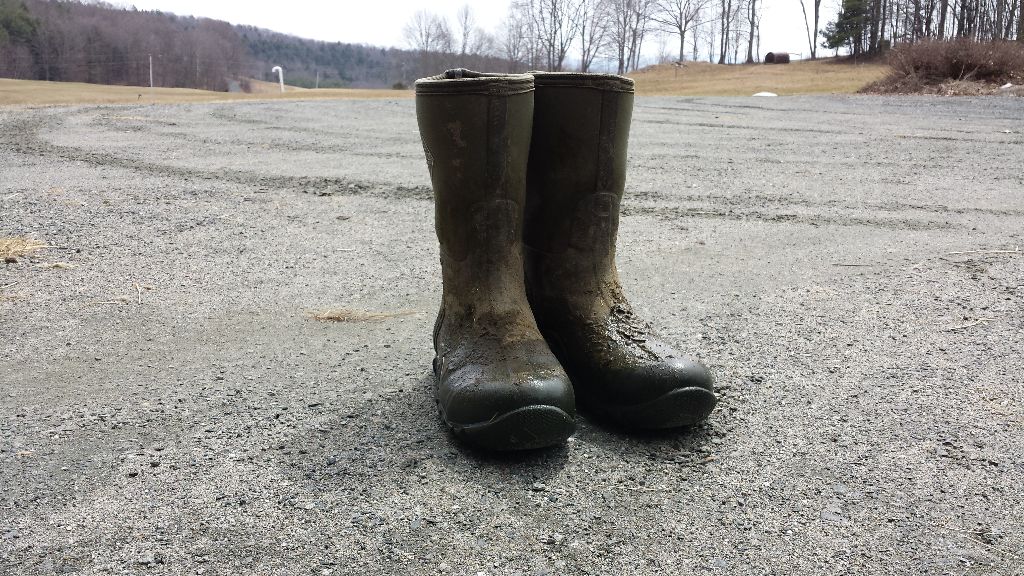
Muck Boots
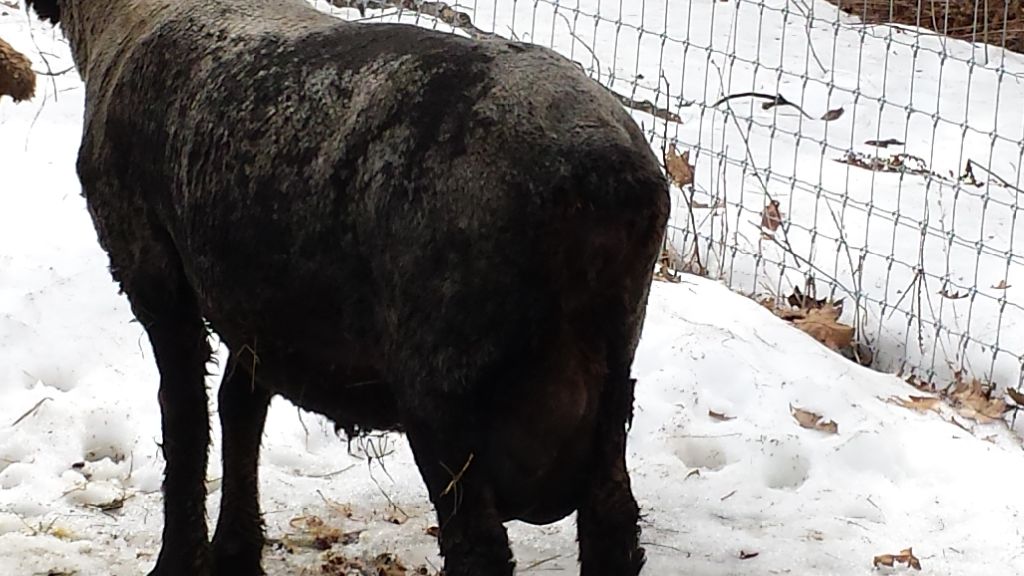
Martha’s Udder
Todd
We are checking blog daily for news of baby lambs.
Checking in daily with great anticipation. Hoping the home fires were quiet in Peg’s absence!!!