
Ken Hamblin is a dead ringer for Dennis Hopper if Dennis Hopper grew out his remaining hair and pulled it back in a rat’s tail. And like Dennis, Ken is an artist, a craftsman, but his medium is wood. I found Ken through his son Kenny who had a booth at the Farmer’s Market showcasing his stone carvings of bird baths, dice, lamps, and signature crosses. Tucked among the stone pieces were a few primitive wood frames, benches and boxes that appeared to have been made from old barn siding with classic red faded paint, white trim and weathered browns and grays. The pieces were simple, clean, unpolished and inexpensive. I was looking for a solution for our powder room and asked Kenny if the benches could be custom ordered. “My dad does the wood pieces and sure.” He gave me a card and I called that afternoon with the dimensions. I wanted a 20 x 20 bench. The next day, Ken called to tell me it was ready and asked if I could come by to pick it up.
Ken’s compound is at the top of a private hill carved up by family with a narrow steep dirt road winding by each enclave starting with a camper on blocks, topped with an enormous mouse rack, followed by various structures in varying degrees of aging. A rusted ax wacked into a tree stump marks the entrance to one residence. Only a small yellow sign with the hand painted word “studio” nailed to a tree encourages us (Todd went with me) to continue to climb. Toward the top on the left we pass a cemetery of stone crosses, an arched hobbit-like structure faced with gray cement and outlined in stone forms the studio and showroom, then the road ends in a wide turn-around in front of a natural brown wood framed single story house.
Kenny greets me and moments later his dad comes from the house and we stand in front of the hobbit structure. Ken and Kenny are stone masons, and as always happens up here, it turns out we’d already met Ken the Dad back in the summer of 2013 when we loaded our truck with three hundred pounds of fleece from a deadman’s barn over in Thetford. As we tossed black plastic bags of old Merino fleece out the second floor opening Ken was there advising on the options to repair one of the barn’s retaining walls.
“I remember you guys. Whatcha do with all that wool?” We quickly explain how we turned it into blankets at a mill on Prince Edward Island but then told him about finding five pounds of pot in with all the bags of fleece. “You didn’t keep it?” “Nope. Since you were standing there, we told the son in law we indeed found the ‘bag’ he thought we might come across and told him where he’d find it up under a rafter.” The way Ken shook his head I think he’d have done differently.
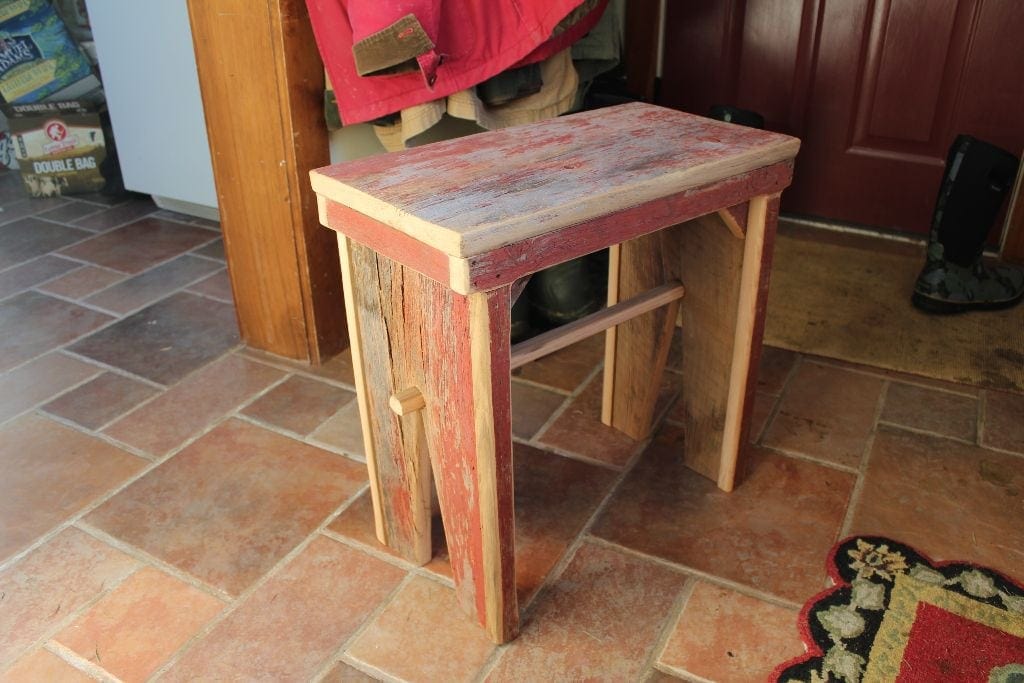
After a little more meet and greet, we got down to business. Ken went into his showroom and came out with a lovely bench, just the right size. “I like the square dimensions. Need to make more like that. Hadn’t thought to do square ones.” Like a lot of Ken’s work, it was made of old red barn siding he sources from a barn mover in the area. “I get the scraps.” It’s a simple design with a top, two notched panels for legs on each end held sturdy by a wood dowel wedged into the top of a notch. All the edges are trimmed with old wood freshly cut and sanded to give the piece a very clean finished look. “It’s perfect. Really. Wow.” Inside I’m tickled pink, but nervous that this custom bench made so fast and so well is going to cost more than what I’d seen at the Farmer’s Market. “What do I owe you?” $45.
I drove home feeling like I’d scored big time and wondering what else Ken could make for us. During a Christmas visit I figured out what we needed next. My sister Liza has an antique wooden rack next to her family room couch that she uses to hold magazines. Todd took a few pictures and I came home with a plan.
To date, we’ve been using a wide woven basket on a child’s chair to hold a mixed up pile of mittens, work gloves, ski gloves, scarves, hats and it drives me nuts. With dimensions on a scrap of paper, I drove over to see Ken on a sting-your-fingers-off frigid morning a few weeks ago. He took me into his work room, apologized for the lack of heat – something had busted the day before – and he recounted pulling up floor boards out of the attic of a 1746 home in Claremont a few days earlier. “ It’s called King’s Wood because he owned all the land and the trees were all kinds of wide, some 25 inches some 40, what you don’t see any more. This is wood you can’t buy in a store.”
I showed him my drawing, explained the kind of low trough on legs I was looking for, and forgot to show him the photo. But he got it right away. “And I’ll make it out of those planks I just got.” I was thrilled.
“One more thing,” I said, “I need a donation box and I’m hoping you can make me one.” At the November Jericho Community Club meeting in the neighborhood’s one room schoolhouse when the discussion of donations came up, I suggested it might go better if people could donate anonymously (instead of literally passing a hat), like in a box of some kind, and found myself, out loud, proudly volunteering Todd’s skills since he was doing so much carpentry work for the sheep. I had no idea what I was offering and when Todd and I took up Erik’s offer to see how his router and jig set up could do fine dovetail joints I knew I’d gone down the wrong path. I had no interest in mastering this complicated piece of equipment and Todd’s relative silence during the demo confirmed he didn’t either.
It had been years, but Ken knew of the schoolhouse. “A little before Steve Sass’s place.” Yup, that’s it. Volunteers maintain the schoolhouse and donations help pay for some of the upkeep. In Ken’s narrow showroom next door to his cavernous work space, he had some recipe and jewelry boxes with curved tops that were close to what I thought could work, “but,” I said, “Ken do whatever you think works. It needs a slot for money and maybe some way to keep it locked, and it needs to be light enough to pass around.” I left it at that because I had all the wrong clothes on and was feeling the stinging pain of cold in my fingers and toes. Two weeks later, warmer weather arrived and Ken confirmed the projects were complete.
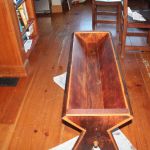
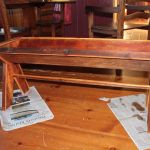
Todd and I drove back to Hamblin Hill Sunday morning to see what Ken had created. This time he had us meet him in his kitchen which is a charming space of stone, wood, high end appliances, and friendly dogs. First he brought out the trough – perfect – and then the box, a simple rendition of a Vermont school house – also perfect. His wife Robin joined us and we all agreed the trough was a great solution for winter gear. Ken advised that we should rub it down with linseed or tung oil and Robin pointed out a warm natural dark brown wood beam to show the color it would turn. Then I turned to money. Ken explained the trough had to be $60 because he ended up having to use two of the 1746 beams to make it, and the school house box was $25. “It’s a good lock. If you don’t want the lock, it’s $20.”
I wrote the check, asked if he knew Long River Studios in Lyme because I thought his work belonged there and Robin said, “he needs a salesperson. Really. He doesn’t do that well. He needs someone to do the sales.” We said our good byes, put the trough in the back and the box on the seat and drove down the winding snow covered dirt road past the workshop, stone crosses and various family compounds. I don’t know how you sell ingenuity, economy, character, and craftsmanship, but this entry is my start. (click on a photo to see it more larger & more clearly)




Peggy
Very nice work! Kenny laid Bob’s flagstone from the driveway to his front door! Great guy!!!