
Sunday morning, I got up early and hit the road by 6:15. Destination – Canada. Almost. Two and a half hours and 132 miles later, I pulled into Parson’s Farm in Richford, VT – about two miles from the Canadian border. The radio had a lot of French stations for the last half hour or so.
For the next four hours, I participated with about 15 others in Chet Parsons’ course, “Parasite Control of Sheep, Goats and Camelids”. We didn’t really do formal introductions, but most of my classmates were, like us, fairly new to sheep (and goats). One couple didn’t even have them yet.
As Chet got started, I asked him how long we’d be together. “Well, we’re going to run long today, I’d say one o’clock.”Fine. We began in Chet’s kitchen, with two rows of chairs and stools lined up against the wall, Chet up by the kitchen counter which had a laptop and a projector on it, and a screen in front of the kitchen cabinets. Tight, but it worked fine. Coffee and homemade scones were offered, and we were on our way.
Chet is recently retired from the Vermont Extension Service, and is putting on a series of ten classes in his “Master Shepherd Program” for the Vermont Sheep and Goat Association. Being members, we got a 20 percent discount on the class. He is a thorough teacher, and got us started with the Greek origins of the words “parasite” and “nematodes”, as well as a brief taxonomic discussion. There are roughly 12,000 known species of nematodes (worms), but experts estimate there are probably 500,000 species in the world.
The primary species that brought us together is haemonchus contortus – also known as the barber pole worm. Before we went into Chet’s kitchen, he had us look at stage 3 haemonchus larvae through a binocular microscope he had set up on the bed of his pickup truck. Clear little buggers that contorted around on the petri dish. He had harvested them from sheep poop that he collected from his field and soaked in water for about a week.
I’d heard the name “barber pole” before but had never given it much thought. Chet told us the worm’s digestive tract runs the length of its long slim body, and when it sucks blood from the sheep’s rumen wall, it looks like a barber pole.

Barber Pole worm
A lot of what Chet talked about was fairly familiar, but he shared more than enough pearls of wisdom to make the trip worthwhile.
- Rotational grazing: While it definitely makes a lot of sense to move sheep around to new grass on the pasture, Chet couldn’t really give a firm answer on how often to move them. This was a little different from advice we received last year from another retired Extension Service professional who told us to move them every day or two. Chet said it really depends on each farmer’s particular situation – how many sheep, how many acres, the quality of the grass. The chief point is to keep the sheep from grazing down too close to the ground. Worms need water to live and move, and dew and rainwater are more prevalent closer to the ground.
- When is it “safe” to go back on grass that has been eaten earlier in the year? Next year! This was an eye opener. We’d heard about the life cycle of the larvae, and something like 3 or 6 weeks would pretty much kill them off. Not so. The longer you wait, the better, but there will still be larvae in the field.
- Another reason to bring sheep into the barn at night – worms. Since the larvae need water to live and move, if you bring sheep in at night and wait until the dew is off the grass in the morning, they are less likely to eat the larvae in the grass. We won’t be following this approach anytime soon, but it is something to consider for the long run and as we think about building a larger barn.
- Deworming strategy: Chet told us there are three different classes of Anthelmintics – deworming medicine. We have been using two. The best strategy for using these is to use one until it loses its effectiveness – the worms build up a resistance to it – then move on to another class. We have been using them interchangeably, which means the worms will build resistance to both classes at the same time. Fortunately, we are so new to this we haven’t used either class much at all. We should just pick one and run with it for awhile.
- The logic behind de-worming only the sheep that need it: If we deworm every sheep every time, each sheep will be left with a small amount of resistant worms in their stomachs, still eating, mating and laying eggs. Those eggs will go out on the grass with the sheep poop, turn into larvae, get eaten with the grass, and the cycle will repeat itself yielding a next generation of worms that is likely to be resistant. But if we deworm only when necessary, less resistant worms will also be eating, mating and laying eggs; and when those eggs hatch they can grow up and mate with the resistant worms, thus WEAKENING the overall gene pool of the worm population!
- The 80/20 rule: Like so many other things, it turns out that 20% of any particular flock will be responsible for producing 80% of the worm eggs. So if we can identify the sheep in our flock that are major egg producers and deworm them, the overall worm population will go down dramatically. How to do that? Fecal Egg Count! Chet showed us how to do that, too.

Haemonchus Egg
I think I’ll stop there. I hit the road at one o’clock (we could have been done sooner, but Chet has an easy going style of education) and Peg called about 30 minutes later, “Well, did you get the card?” For an extra $15, we could purchase a FAMACHA card, which is only available to people who have taken a class like this and been trained on the FAMACHA method of checking sheeps’ eyes for signs of anemia.

FAMACHA Card
Nope, no card yet. Chet explained at the beginning of the class he had sent off to receive a supply of cards to hand out, but they hadn’t arrived in time. He’ll mail them out as soon as he gets them.
This morning while we were treating Calvin, Levi and Schuyler for hoof rot we had discovered last week, I was able to check all their eyes – deep dark red. That’s a great sign – it means there aren’t many worms inside.
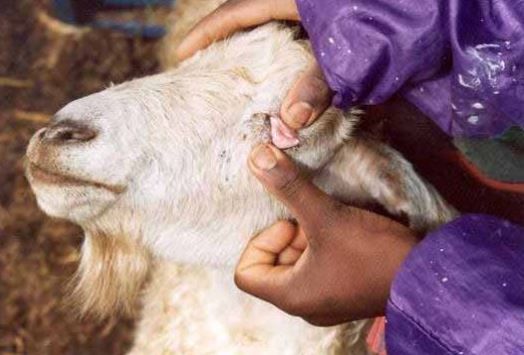
Checking Eyes
Oh, one last bit. Chet told us where the name FAMACHA comes from. I thought it was an acronym. Nope, its named after its creator Dr. Francois “Faffa” Malan. FA ffa MA lan CHA rt. Clever.
Todd