
I’d like to challenge the notion that dyeing is easy, comedy is hard. For the last two weekends Todd and I have carved out some time to experiment with dyeing four ounce skeins of yarn we purchased from a farm over in Thetford. It’s good wool, but since it’s not from our sheep we felt learning the ways of pigment on fiber was best done on imported, foreign product. Thetford is hardly Taiwan, but when it comes to making lofty claims at the local farmer’s market, you want to stay honest. We purchased about 45 skeins of white merino single ply wool and about a dozen gray and oatmeal colored merino as well from Nancy who was trying to empty out ten-plus years of yarn she’d had milled from her flock of sheep.
I had poured through two books on dyeing wool – both of which waded into color charts, color theory, and color mixing. As an amateur oil painter, I skimmed these chapters quickly and got bogged down reading about the small sample tests they recommended. Tedious, I thought. I’m just going to take the plunge and squirt color on sections confident they’d blend well and look like a section of Monet’s lilies and of course I screwed up about 4 skeins with horrible mixes of puke green and cloudy blues. My sister arrived a few weeks later and together we worked on being more systematic about the process, but it became clear that dyeing wool in spaghetti pots on the kitchen stove was tough and toxic. She went on line and ordered a 40 gallon stainless steel pot and I went on line to find a way to move the whole process to the garage. The Bayou Classic gas stove arrived about a week after the giant pot that could feed any army showed up.
Eileen returned to the farm and together we spent an afternoon carefully reading the book that seemed to have the most basic details about how to measure out the dry pigment, make a dye stock, pre-soak the yarn, make a dye solution, and how to slowly cook the yarn until all the pigment becomes absorbed by the fibers. In other words, ignorant improvisation was replaced with an effort to buckle down and follow the directions. We carefully weighed, measured, stirred, blended colors and in short, did as we were told. The results were encouraging. Once dry, I organized a means of recording the recipe and a sample so over time I’d have some sense of what the heck the different powder combinations were capable of doing to the wool.
At the next Farmer’s Market, those colored skeins we created sold quite well. And that’s when Todd stepped in to say, “I guess I better learn how to do this too if we’re going to keep the supply up.”
Our first weekend of dyeing together was really more like me in the garage dyeing and Todd working on a project nearby – stepping over to help when needed, but yesterday, we were a team sharing all the tasks and cranking through three batches of yarn, three skeins each.
What makes dyeing wool so tricky is that what you see is not what you’ll get, especially at first. Our first batch was a blend of sky blue and deep orange. The moment we submerged the three skeins into the giant vat of dye, we both thought we had a failure on our hands because the yarn looked like pale flesh. While the flame heated the pot, I headed inside to figure out what we could add to the pot to salvage the awful mess. When I returned to the garage, the magic had begun. As the water warmed, the blue pigment began to leach out of the water and dye the wool. By the time the water had hit 160 degrees, we had a wonderful deep purple blue that had plenty of punch on the skein that had started out white, but more impressive was the deep variegated results of the blue over the skein that had started as grey. Surprised by our victory, we were both wondering what we should try next. The second batch was a blend of blue, yellow and red, while the third was 50% crimson red and 50% yellow.
We’ll head to the farmer’s market with a load of colorful yarn we dyed. Those skeins will be a stark contrast to the natural shades of brown and gray yarns from our own flock of sheep. Soon we’ll have to decide if, when and how, to dye over the natural colors of our own, home grown yarn. Hopefully, all the experimentation on the bought yarn will have prepared us. Stay tuned!
Peggy
-

- Waiting for 160 degrees
-

- Pre-soaking the yarn
-
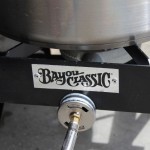
- Bayou Classic
-

- Dyeing Setup in Garage
-

- Peg Likes the Blue
-

- Blue and Green almost done
-

- Last Batch – Orange
-

- It’s Done!
-

- This week & Last Week Colors