
After cleaning out the heated waterer on Saturday (see Saturday Chores post) and seeing no visible change in sheep behavior (meaning, they’re still not drinking out of it), I went on the website of the manufacturer, Ritchie Industries (“Fresh Water for Life”), and sent them the following request on Sunday morning:
Hi: We purchased a waterer this fall for our sheep. We can’t seem to get them to drink out of it. Yesterday we scrubbed it down as much as we could, rinsed it completely, still don’t think they are taking to it. Any suggestions?
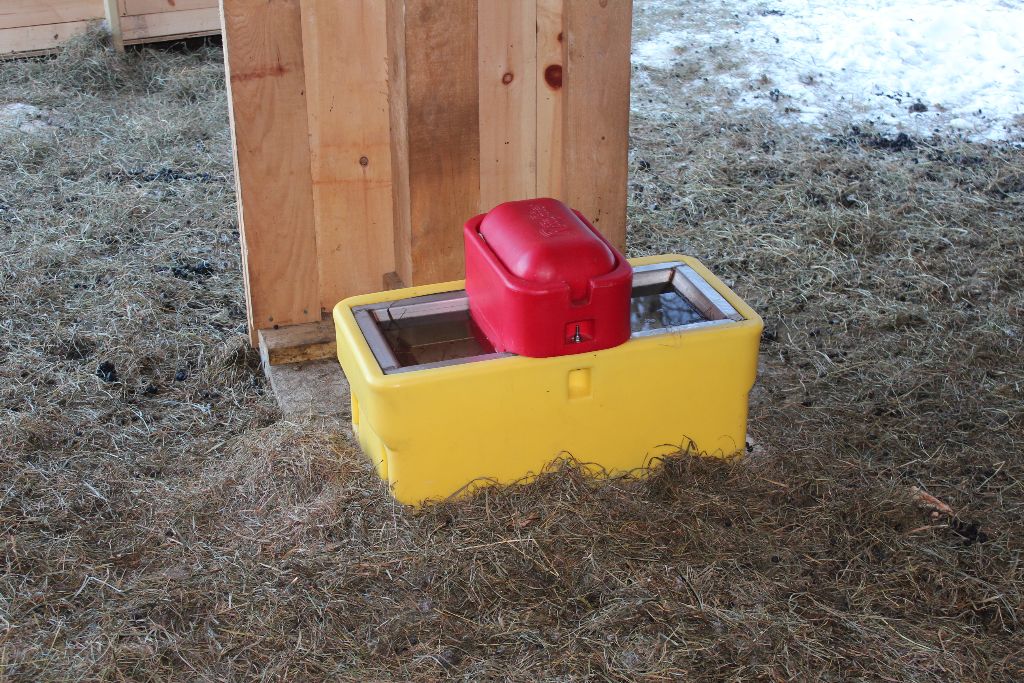
Waterer That No One Uses
Monday morning, I received an email from Ruth:
What model did you purchase? Have you noticed any other odd behavior from your sheep around the unit? Do they have another water source in their area and have you tried to remove it to see if they will drink from the unit?
Me:
Hi Ruth: Thanks for your quick response.
Omni 2 special. I can’t say we’ve noticed any strange behavior. When they first were in the barn with it this fall, there was some sheep poop in there, which we obviously cleaned out. We did a major cleaning/rinsing this weekend and then left them with it for a few hours with no other water source. When we saw them eating snow/ice off the ground in the barnyard, we put a heated water bucket in there. That gets emptied by them. Do you think we should go “cold turkey” meaning no other water source? We just get concerned when we see them eating a lot of snow/ice.
Ruth:
Is the waterer placed near an electric fence?
Me:
No its not. I mentioned our dilemma to a friend this morning and he asked if they might be getting shocked. I’ve put my hands in the water, and haven’t felt a tingle. The nearest hot wire is about ten feet away.
Ruth:
It would be my concern that you are picking up a stray voltage from something on your property. You will not be able to feel this with your hand as it is not sensitive enough. The sheep are going to feel the trickle through their tongue or mouth. I would suggest contacting your local electric company or an electrician to test the unit for a voltage. Do you have the unit grounded at the unit?
Me:
OK, thanks. Something for us to work on.
“Stray voltage?” Never heard of it. Sounds like the name of a new rock band. I phoned Willie, a great electrician who did all the wiring for the barn (including the waterer). When I told him of our dilemma, he volunteered to come up and do exactly what Ruth suggested – test the unit for voltage.
Tuesday afternoon, I get a voicemail from Willie. He came by the farm while Peg was runing an errand, so just walked into the barnyard with his tester. Sure enough, he’s getting 0.7 volts, but not only on the waterer. He tried the tester on a piece of electric conduit and got the same reading. He shut off the power to the barn at the circuit box in the barn, and still got the reading. He offered to come back Saturday morning to try a few more things. He also said he didn’t know much about stray voltage, and in fact was searching the internet about it when I returned his call.
Saturday morning at nine, Willie’s at our door. “Let me get out of my pajama pants, Willie.” “Fine, I’ll meet you up at the barn.”
In addition to walking me through what he had done on Tuesday afternoon, we shut off all power to the house and barn, turned off the generator, and kept getting the reading. He even disconnected a ground wire in the barn circuit box, and the reading actually went UP to 1.0 volt. He had expected it to go down, if anything.
Next step: I get to call Green Mountain Power. Willie suggested I ask to speak with an engineer. Great. Me talking to an engineer, might as well try to have the conversation in Russian.
Willie shared a story about a farm in Plainfield that had a metal trough experiencing stray voltage – the power company had to string TWO MILES of new line to solve the problem.
In anticipation that our problem will not be solved soon, we moved one of the heated water buckets from the boys side to the barn this week (the ewes seemed to avoid a water bucket placed on the ground with a heater placed in it – that went to the boys side). I also ordered a third heated bucket from Amazon, which arrived Friday and I installed Saturday. The girls now have three 6 gallon heated water buckets, and we have to make sure they are full and stay plugged in.
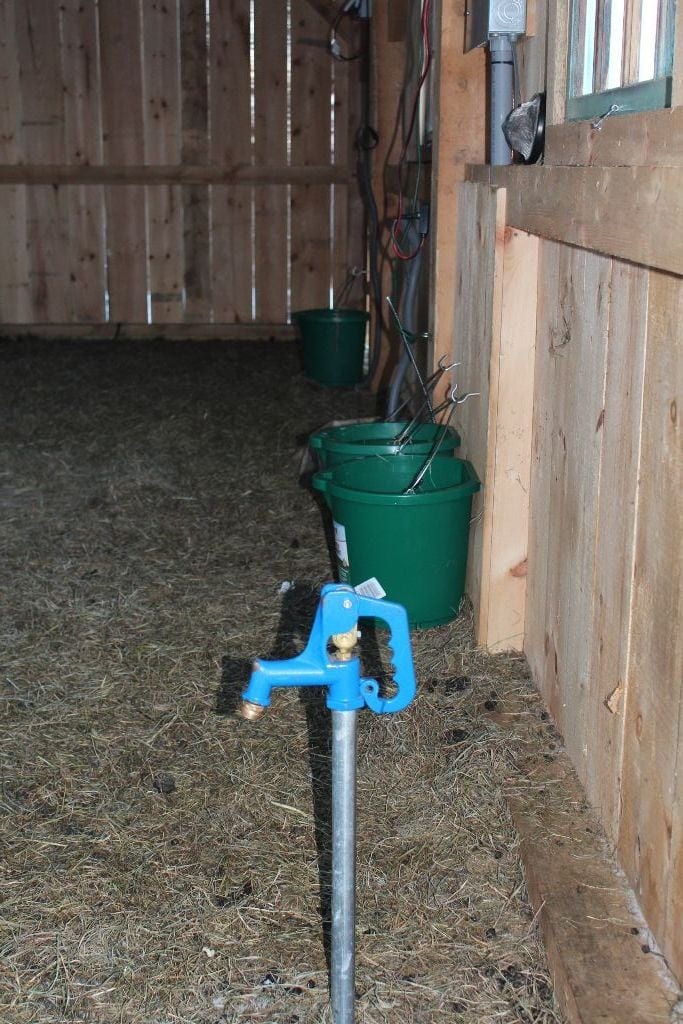
Barn Faucet & 3 Heated Buckets

Filling up

Bucket cords knotted to prevent power failure and freezing

Extension cords held up high so sheep won’t disconnect
It’s been a busy week, so I didn’t get a chance to search “stray voltage” myself until Saturday afternoon.
- Stray Voltage is an extraneous voltage that appears on grounded surfaces in buildings, barns and other structures. Stray Voltage is classified as a low frequency form of conductive Electro-Magnetic Interference (EMI). In most buildings stray voltage is not a problem because the levels are generally below the perception level of humans and usually there is no sensitive electronic equipment which can be affected by it. However, Stray Voltage or EMI is a major problem for Hospitals, Manufacturing Plants and Farms.
- Farmers need to select electrical equipment, including lights, that will not generate excessive ground currents. Lighting ballast, electrical motors and auto-transformers are primary sources of leakage current even when they are UL approved and working correctly. All electrical equipment needs to be tested for leakage before it is installed. If the leakage currents is in excess of 1 milliamps (0.001 Amps), then the equipment should not be used.
- The electrical utilities do all of the wrong things relative to stray voltage. They consider ground to be the same as neutral and they connect the primary neutral and the secondary neutral together at their distribution transformers. The neutrals are then connected to water pipes and building structure of the building. All this results in the potential of the building structure and piping being elevated to the voltage level of the utilities neutral conductor. This is the primary cause of stray voltage on a farm. The good news is that this kind of stray voltage can be eliminated quickly and cheaply by insisting that the electrical utility separate the primary and secondary neutrals on your transformer.
- Stray Voltage IS a rock band based in the Milwaukee, Wisconsin area.

Stray Voltage Band
Todd
-

- Christine greeting me
-
- Ewes greeting me
-
- Ewes waiting for me to leave
Learn something new everyday.
Is GMP going to fix the problem for you? I bet you never thought you’d be learning about electricity when you started sheep farming. Interesting.
Having a problem with Ritchie horse waterer shocking horses and or tripping the GFiC outlet, there is an electric fence 20′ from waterer. It trips even when fencer not plugged in, was intermittent but now I’m mediately trip GFIC. The Elec souce branch circuit is 20′ from waterer. I will try separating neutral and copper wire in branch box.