What the heck is “micron testing” and why am I blogging about it? After shearing the flock last weekend, we took all the fleeces in their plastic bags down into the basement. We set up the skirting table again and tried to pick out more hay and even pulled out some tufts of fleece that had lots of hay (typically the back of the neck just behind the ears). Peg then cut out two inch swatches from the fleeces of Calvin, Eleanor and Hilary, and I put each swatch in a labeled plastic sandwich bag.
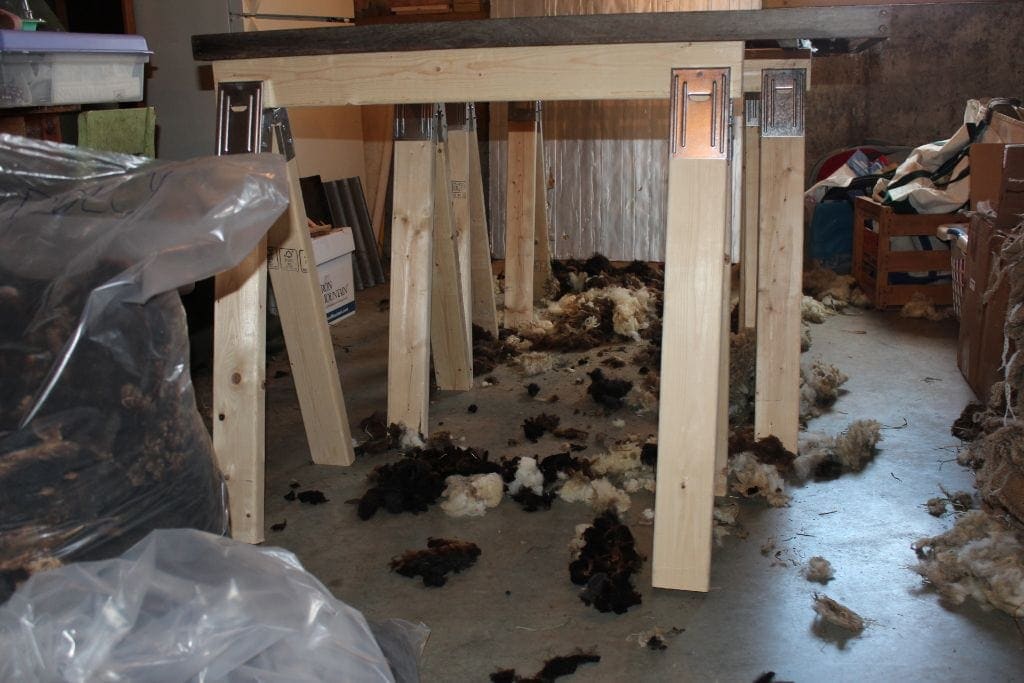
Second Skirting
Monday, I mailed the swatches to Yocom-McColl Testing Laboratories in Denver. This morning, I received an email from Margaret McColl with several PDF attachments. Talk about fast turnaround. For $9.50 a swatch, Peg and I now know how fine are our fleeces.
The Sirolan Laserscan Micron Test Results are as follows:
Calvin:
- Mean Fiber Diameter: 26.9 microns
- Standard Deviation: 5.2 microns
- Coefficient of Variation: 19.3%
- Fibers Greater than 30 microns: 22.8%
Eleanor:
- Mean Fiber Diameter: 27.3 microns
- Standard Deviation: 4.7 microns
- Coefficient of Variation: 17.2%
- Fibers Greater than 30 microns: 22.6%
Hilary:
- Mean Fiber Diameter: 26.8 microns
- Standard Deviation: 4.8 microns
- Coefficient of Variation: 17.8%
- Fibers Greater than 30 microns: 18.8%
OK, in English please? We’ve been told that Corriedales yield pretty fine wool, not as fine as Merino, but desirable to spinners and knitters. Coarse wool is itchy against the skin, fine wool is not. There are three wool grading systems. The oldest – the blood system – is based on the bloodline of the sheep. Merino and Rambouillet are called fine. Wool types grown on sheep with fractional quantities of Merino or Rambouillet are called 1/2 blood, 3/8’s. 1/4, low 1/4, and common. Corriedales would likely be in the 3/8 range.
A more quantitative grading method is the count system – it counts the number of “hanks” that can be spun from a pound of clean wool. A hank is 560 yards. Fine wool yields more yarn per pound. Counts range from 80’s (44,800 yards) to 36’s (20,160 yards). Corriedales range from 58’s to 50’s.
The micron system measures the average fiber diameter and is the most accurate grading method. There are 16 grades, ranging from about 18 microns to 40 microns. A micron is 1/25,400th of an inch. So based on the above results, these three sheep have medium grade wool with a count grade of 56’s, at the finer end of the range for Corriedales. Also, the standard deviation is pretty low – 56’s can have a maximum standard deviation of 7.59. Our highest, Calvin, is 5.2. This means there is less coarse wool in the fleece.
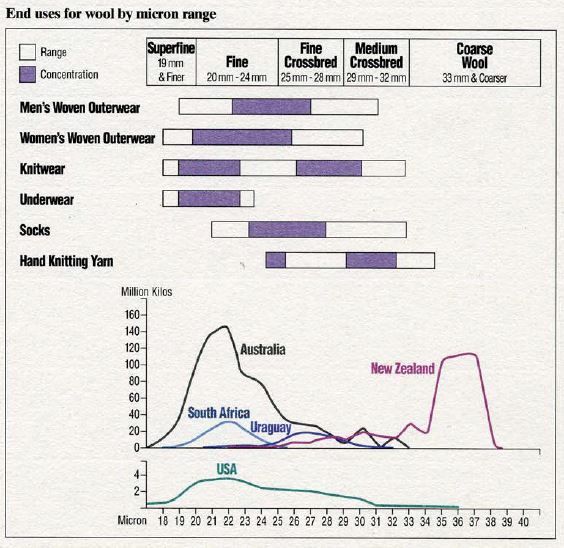
The chart below comes from another PDF sent by Yvonne – Wool Grades and the Sheep that Grow the Wool. This classifies the wool as “fine crossbred” and is suitable for woven outerwear (more likely men’s than women’s?), knitwear, and socks. I find it puzzling that the concentration of hand knitting yarn is either 23-24 mm or 29-31 mm, essentially sandwiching around our ~27 mm.
Why did we test only these three sheep? Well, Calvin being the ram has a say in every lamb we get. We picked Hilary as a representative of the three brown lambs and we were interested to see how the Corriedale Cormo combination would work out. Essentially, the fleeces are identical in fiber diameter and fineness. I think a number below 30 microns is good. As we go to market with yarn and roving, we can tell our customers these numbers. Also, as we get into breeding, micron test results can inform us which ewes to breed. For now, we’ll take all the lambs they will give us.
Todd