
The last few weeks we embarked on a different approach to rotational grazing with the larger group of sheep living on the west field. For our first two grazing seasons, we would set up “paddocks” every couple days with the movable electric net fencing, move water buckets and various shelters (farmer’s market canopy, homemade shelter on wheels) and the flock from place to place. No real pattern to our movements – just trying to find new, fresh, tall grass for the critters to mow down. At the end of October, 2013 we had 6 ewes, 2 ewe lambs, and 2 wether lambs – 10 total in the west field – pretty easy to set things for them this way.
But in November we added 7 Cormo ewes and 2 Cormo wethers to the group. January we said goodbye to the 2 wether lambs; April we said hello to 4 new wether lambs and 2 ewe lambs. Now we’re up to 23 out on the west field. This significantly larger group had two major impacts on our grazing approach – the paddocks need to be larger, and the sheep need more shelter. As their fleece grows this season, and the temperatures rise and the sun beats down, the sheep will need shade (and sometimes protection from high winds and heavy rains).
So this year we are trying a “hub and spoke” approach in the west field. About three weeks ago we put the farmer’s market canopy, the shed on wheels, the lambs’ creep (which they hardly ever use) and the water troughs in a fairly central location in the field. On the west side of all this stuff we set up a short length of electric net fencing; on the east side we used most of the wooden panels I’ve built – held together with rebar posts. This paddock is the hub.
From the hub, we run two lengths of electric net out towards the perimeter fencing, making a crude pie-wedge shaped paddock – the spokes. We try to make each pie paddock cover roughly the same amount of grass – they seem to consume a paddock in three to four days. It’s been working very well. Hub and spoke looks like it will address the paddock size issue.
But the shelters aren’t enough for 23 sheep. So last week, Carl and Kevin (mostly Carl) built us a 24 foot by 12 foot run in-shed on a fairly level spot next to the current hub. With three walls and a metal shed roof (the open side facing east away from the prevailing winds), we hope this shed will be big enough.
I took Tuesday off from work to “help out”. Kevin and Carl showed up around 8:45 with both of their trucks loaded with lumber. Carl had cut the lumber for the siding at his saw mill and prepared the timber frame pieces by cutting mortises and tenons. We asked for the shed to be built on “skids” so that we could move it (with the tractor we don’t yet own) from place to place in the field. Since there aren’t footings for the frame, Carl used a combination of larger (and heavy) 6×6 pressure treated beams for the bottom frame, and post and beam timbers for the wall frames. This design should be able to withstand occasional moves.
Marty was pretty sure those trucks would get bogged down in a wet part of the field just by the gate, so he brought up a flatbed trailer behind his tractor, we transferred the lumber to it, and he towed it up to the job site. Kevin and Carl used a laser level and a handful of various sized shims to set the bottom frame on the grass, and Kevin was off. Carl explained there was nothing for me to do, and he set about constructing the two short wall frames, which he called “bents”. Around noon, I came back to the job site and helped him raise the bents. He screwed the posts into the bottom frame (temporary fix – needed T-frame hardware was on back order), screwed inch-wide holes in the tops of the posts and pounded six inch pins in the holes to secure the joints. Next we put the top beam for the back long wall on the posts, set the knee braces, and Carl drilled another set of holes. He let me pound in the pins.
That was pretty much it for day one. The beam for the front wall requires two people on step ladders, and Carl wasn’t about to let me be one of them. The next morning, Kevin and Carl set the top beam, and Carl spent the rest of the day setting the rafters and starting to nail on the siding. By the end of day three, the shed was essentially completed. This weekend we made a new hub paddock around the shed and our new system is set for the season.
-
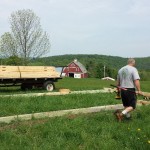
- Day One – Level the Bottom Frame
-
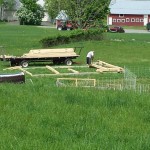
- Day One – Carl @ Work
-

- Day One – Carl Making a Bent
-
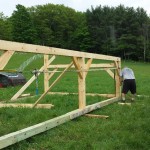
- Day One – Carl Putting Up Top Beam
-

- End of Day Two
-
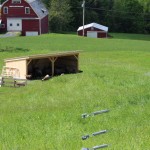
- Shade has arrived
-

- Nice digs, right?
-

- The Shed from Jericho Street
Here is an aerial view of the west field (from last fall), showing the shed, the hub paddock and roughly where we’ll place the spokes for the pie-wedge paddocks. If each paddock holds on for 3 or 4 days, we won’t be returning to a paddock for 6 weeks, which is what the books and experts advise to keep the parasite population in check.
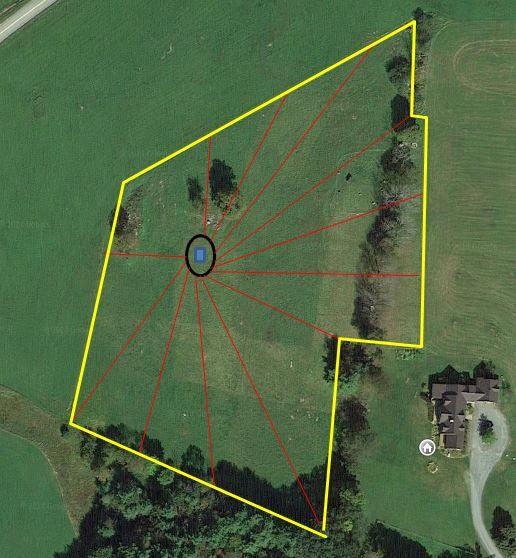
Hub and Spoke Paddocks
Peg and I took a bike ride Sunday, and saw Carl working on a frame at Henderson’s Nurseries on Rte. 14. We stopped to thank Carl for his good work. He asked if the sheep had gone into the shed yet. Peg replied that they had. Carl laughed and said “Marty told me the sheep would never go in there!” Marty also told Peg last spring that the sheep didn’t need coats to keep them warm.
Todd